



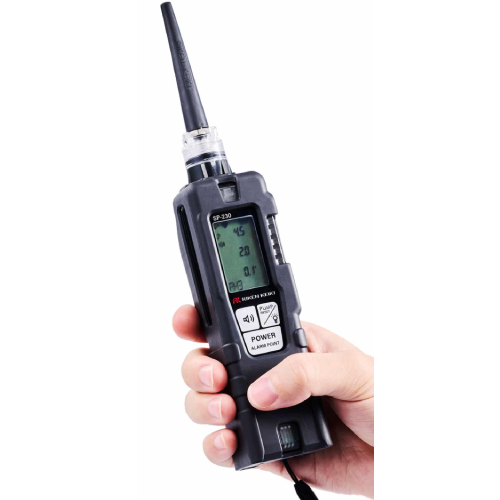
SP-230 Gas Leak Checker

002742-HW-RKI-042
Overview
The model SP-230 is RKI’s latest product offering for leak detection of combustible, toxic, freon and fumigation gases. The SP-230’s rugged, light weight design and fast response time plus ease of operation will make pinpointing hard-to-find, low concentration gas leaks a simple procedure.
| Model | SP-220 TYPE FUM (Fumigation) | SP-220 TYPE SC (Toxic, Combustible, CFC) |
| Target gas | Refer to the gas list below | |
| Detection principle | Hot-wire semiconductor method (MOS) | |
| Measuring range | Depends on target gas | |
| Accuracy | Displays 0.1 ppm-bar when 0.3 ppm PH3 applied. | |
| Alarm set point | Depends on target gas | |
| Alarm pattern | Gas alarm : Gas concentration reached or over the setting point. Trouble alarm: Sensor connection / breaking, Low battery, Low flow
Circuit error, Calibration error | |
| Alarm method | Non-latching | |
| Display of alarm | Operating status icon, flow confirmation icon, operation tone icon, alarm sound icons, alarm setpoint display, battery level icon, bar meter display, mode display, gas name/message display | |
| Sampling method | Sample draw | |
| Response time | 10 sec.: Time to reach 0.1 ppm when 0.3 ppm PH3 applied. | |
| Output signal | IrDA | |
| Display device | LCD | |
| Display contents | Gas name, Gas concentration, Time, Battery, Pilot indicator, Pump display indicator, Sound | |
| Power source | 2 AA Alkaline batteries | |
| Continuous operation | 13 hours or more (25℃, no alarm, no lighting) | |
| Operating temp. & humidity | -4°F~+131°F (-20~+55°C), 0~95%RH (Non-condensing) | |
| Dimension & weight | 7.87”(H) x 1.69”(D) x 1.85”(W) (41 × 186 × 38 mm) excluding projections 7.7oz (220 g) | |
| Ingress rating | IP-67 | |
| Function | Manual LCD backlight (Automatically ON when alarming), Peak value, Snap logging, Time, Cal alarm | |
| Standard accessories | Hand strap, Rubber cover, Tapered nozzle | |
The SP-230 type SC version uses a hot-wire semiconductor sensor (MOS) that can detect a range of target gases including PH3, CH4, H2, HCL, HBr and NH3. The SP-230 type FUM version also uses the same MOS sensor and can detect fumigation gases including phosphine, methyl bromide, carbon disulfide, methyl iodide, hydrogen cyanide, sulfuryl fluoride and ethylene dibromide.