



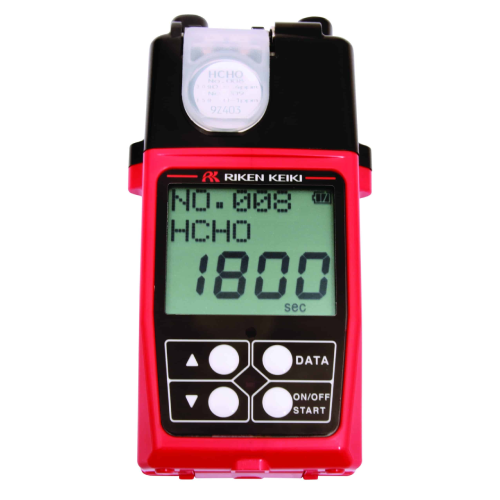
Formaldehyde Gas Detector

002741-HW-RKI-041
Overview
The FP-31 is a highly sensitive portable gas detector specific for formaldehyde detection. It uses a photoelectric photometry method which utilizes colorimetric tablets for detection. A tablet in placed into the instrument, and then a room air sample is pumped onto the tablet for either a 15 minute or a 30 minute period. If formaldehyde is present, it will cause the chemically impregnated tablet surface to darken or stain.
| Detection gas | Formaldeyde (HCHO) in air | |
| Detection range | 0-0.4 ppm (0.005ppm/digit) | 0-1.0 ppm (0.01 ppm/digit) |
| Detection time | 30 minutes (1,800 sec.) | 15 minutes (900 sec.) |
| Detection principle | Photoelectric photometry method | |
| Detection method | Colorimetric tablet method (accumulating measurement) | |
| Accuracy | ± 20% of reading or ± 5% of full scale (which ever is greater) | |
| Display | Digital LCD | |
| Sampling method | Sample drawing with built-in pump | |
| Operating conditions | -10 ~ 40ºC (14 ~ 104ºF), below 90%RH | |
| Memory | Up to 99 readings (automatic recording at the completion of measurement) | |
| Self-diagnosis | Failure of light source and light receiver, low battery voltage, pump failure, system trouble | |
| Power Source | AA size Alkaline batteries (quantity 4) | |
| Continuous Operation | Approximately 12 hours (with no alarm or backlight, with alkaline batteries at 20°C) | |
| Dimension | Approx 85(W) x 190(H) x 40(D)mm, 3.35(W) x 7.48(H) x 1.57(W), | |
| Weight | 500g, 17.6 oz | |
| Standard Accessories | • Detection TAB (20 pcs/pack) ** • AA size alkaline batteries • Operating manual | |
| Optional Accessories | Zero and span tab, datalogging software, USB-IRdA cable (for downloading stored data) | |
| Warranty | One year material and workmanship | |
The magnitude of the stain directly correlates to the level of formaldehyde in the air. The stain darkness is read by an optical sensor in the FP-31, and then the instrument calculates the formaldehyde concentration. The FP-31 then has a direct readout of the formaldehyde measurement on an easy to read LCD display. The unit is capable of detecting very low levels of formaldehyde, in order to confirm if an area contains safe breathing levels. There are no known interfering gases, as shown on the chart on the reverse side of this sheet.