



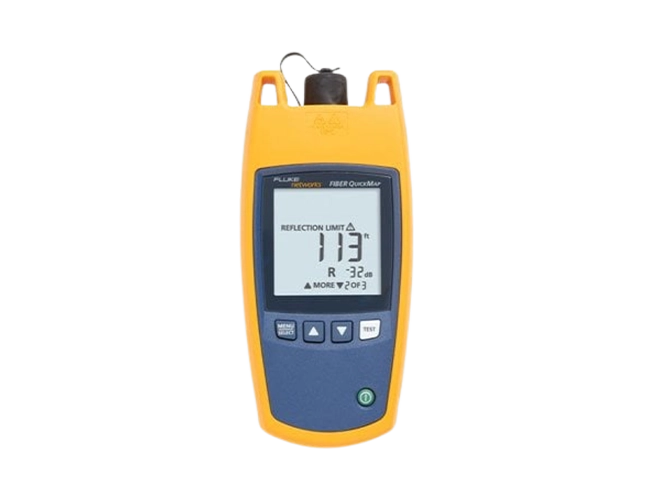
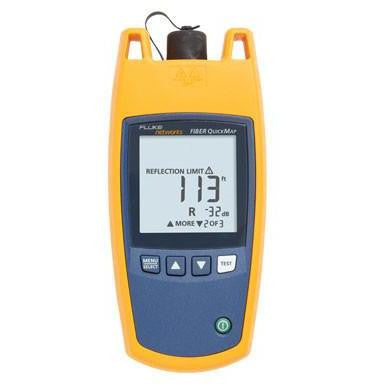
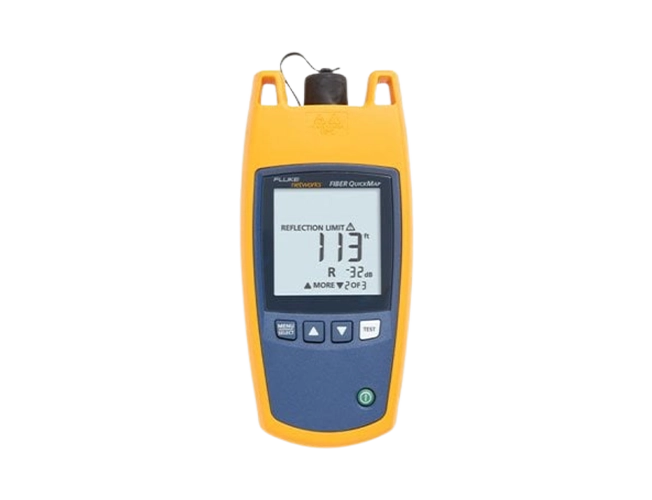
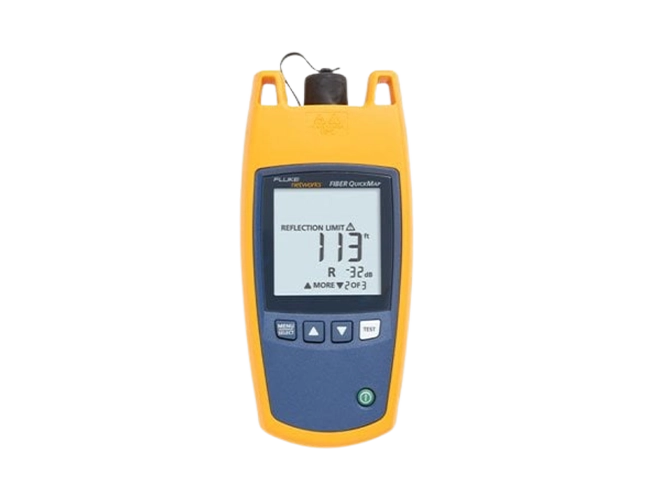
Fluke Fiber QuickMap

00214-HW-FLUKE-015
Overview
Fiber QuickMap bridges the divide between a Visual Fault Locator (VFL) and an Optical Time-Domain Reflectometer (OTDR). Combining the simplicity of a VFL with the capability to provide distance and power information, these models excel in scenarios involving high losses.
| Operating temperature with the battery | 0ºC to 50ºC |
| Non-operating temperature | -20ºC to 60ºC |
| Operating relative humidity (without condensation) | 95% (10ºC to 35ºC) 75% (35ºC to 40ºC) uncontrolled < 10ºC |
| Vibration | Random, 5 Hz to 500 Hz, MIL-PRF-28800F CLASS 2 |
| Shock | 1 meter drop test |
| Altitude | 3000m |
| Battery type | 2 AA alkaline batteries (no battery charger) |
| Battery life | 1500 tests (typical) |
| LCD type | Backlit black and white (segments) |
| Index of refraction range | 1.45 to 1.5 (factory default is 1.496) |
| Factory calibration interval | None |
| Output wavelengths | 850 nm ± 10 nm |
Optical Time Domain Reflectometers (OTDR) provides graphical data and analysis along the entire length of a cable, way beyond the reach of a VFL, but they can be expensive and require more time to and skill to operate.
VFLs work well for exposed lengths of fiber near a patch panel by illuminating bad connections and breaks. They are not very helpful for cable runs more than a few meters, or when the cable is not visible or accessible, or when the laser light can’t penetrate the jacket