



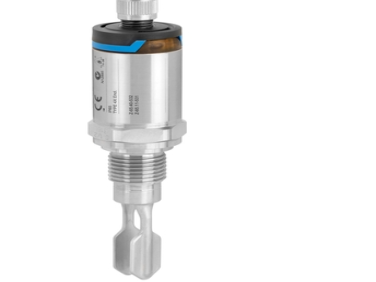
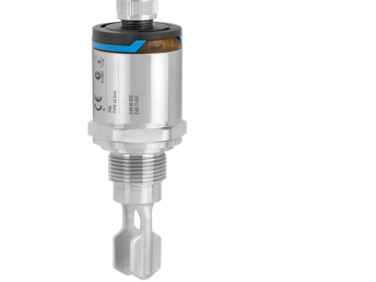
Endress+Hauser Vibronic Point level detection Liquiphant FTL31

007113-HW-ENDRESS-013
Overview
The Liquiphant FTL31 is a highly reliable point level switch designed for detecting liquid levels in a wide range of industrial applications, especially within the machinery sector. Built with a robust stainless-steel (316L) construction, it ensures long-term durability even in demanding environments. Its IO-Link connectivity enables effortless parameterization, making integration into modern automation systems simple and cost-efficient. With no moving parts and full self-monitoring capabilities, the FTL31 provides dependable overfill protection and pump dry-run prevention without the need for calibration or specialized tools.
Measuring principle
Vibration Liquids
Characteristic / Application
Level switch for liquids and is used in tanks, vessels
and pipes.
Supply / Communication
20 ... 253V AC/DC, 2-wire
10 ... 30V DC-PNP 3-wire
Ambient temperature
-40 °C ... 70 °C
(-40 °F ... 158 °F)
Process temperature
-40 °C ... 150 °C
(-40 °F ... 302 °F)
Process pressure / max. overpressure limit
Vacuum ... 40 bar
(Vacuum ... 580 psi)
Min. density of medium
>0,7g/cm³
(>0,5g/cm³ optional)
Main wetted parts
316L
Process connection
Threads:
G1/2, G3/4, G1, MNPT1/2, MNPT3/4, MNPT1, R1/2, R3/4, R1
Communication
AC/DC, DC-PNP
Certificates / Approvals
CSA C/US, EAC
Safety approvals
Overfill protection WHG
Leakage
Design approvals
EN 10204-3.1
Marine approval
ABS/ LR/ BV/ DNV
Options
Adjustment switching delay
Cleaned from oil+grease,
PWIS free
The Liquiphant FTL31 delivers accurate and safe switching performance, completely independent of changing media properties such as conductivity, viscosity, turbulence, or air bubbles. Designed for high environmental and quality standards, it continues to operate safely even in the event of power supply issues. Its plug-and-play functionality and modular design offer configuration flexibility across different process temperatures, connection types, and accessory options. With maintenance-free operation and easy IO-Link configuration, it reduces system complexity, supports efficient engineering, and ensures reliable liquid level monitoring across varied applications.