



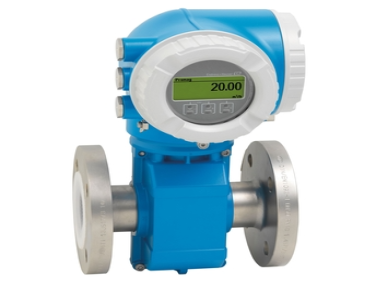
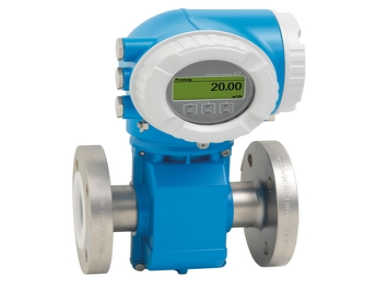
Endress+Hauser Proline Promag P 300 electromagnetic flowmeter

007101-HW-ENDRESS-001
Overview
The Promag P 300 is a high-temperature electromagnetic flowmeter designed for demanding chemical and process applications, offering corrosion-resistant materials, maintenance-free operation, and advanced diagnostic capabilities with Heartbeat Technology.
Measuring principle
Electromagnetic
Product headline
High-temperature flowmeter for process applications with a compact, easily accessible transmitter.
Dedicated to chemical and process applications with corrosive liquids and high medium temperatures.
Sensor features
Diverse applications – wide variety of wetted materials. Energy‐saving flow measurement – no pressure loss due to cross section constriction. Maintenance‐free – no moving parts.
Nominal diameter: max. DN 600 (24"). All common Ex approvals.
Transmitter features
Full access to process and diagnostic information – numerous, freely combinable I/Os and fieldbuses. Reduced complexity and variety – freely configurable I/O functionality. Integrated verification – Heartbeat Technology.
Liner made of PTFE or PFA. Compact dual-compartment housing with up to 3 I/Os. Backlit display with touch control and WLAN access. Remote display available.
Nominal diameter range
DN 15 to 600 (½ to 24")
Wetted materials
Liner: PFA; PTFE
Electrodes: 1.4435 (F316L); Alloy C22, 2.4602 (UNS N06022); Tantalum; Platinum; Titanium
Measured variables
Volume flow, conductivity, mass flow
Max. measurement error
Volume flow (standard): ±0.5 % o.r.± 1 mm/s (0.04 in/s)
Volume flow (option): ±0.2 % o.r. ± 2 mm/s (0.08 in/s), Flat Spec
Measuring range
4 dm³/min to 9600 m³/h (1 gal/min to 44 000 gal/min)
Max. process pressure
PN 40, Class 300, 20K
Medium temperature range
Liner material PFA: –20 to +150 °C (–4 to +302 °F)
Liner material PFA high-temperature: –20 to +180 °C (–4 to +356 °F)
Liner material PTFE: –40 to +130 °C (–40 to +266 °F)
Ambient temperature range
Flange material carbon steel: –10 to +60 °C (+14 to +140 °F)
Flange material stainless steel: –40 to +60 °C (–40 to +140 °F)
Sensor housing material
DN 15 to 300 (½ to 12""): AlSi10Mg, coated
DN 350 to 600 (14 to 24""): Carbon steel with protective varnish
Transmitter housing material
AlSi10Mg, coated; 1.4409 (CF3M) similar to 316L; stainless steel for hygenic transmitter design
Degree of protection
Standard: IP66/67, Type 4X enclosure
Display/Operation
4-line backlit display with touch control (operation from outside)
Configuration via local display and operating tools possible
Remote display available
Outputs
3 outputs:
4-20 mA HART (active/passive)
4-20 mA WirelessHART
4-20 mA (active/passive)
Pulse/frequency/switch output (active/passive)
Double pulse output (active/passive)
Relay output
Inputs
Status input
4-20 mA input
Digital communication
HART, PROFIBUS DP, PROFIBUS PA, FOUNDATION Fieldbus, Modbus RS485, PROFINET, PROFINET over Ethernet-APL, Ethernet/IP, OPC-UA
Power supply
DC 24 V
AC 100 to 230 V
AC 100 to 230 V / DC 24 V (non-hazardous area)
Hazardous area approvals
ATEX, IECEx, cCSAus, INMETRO, NEPSI, EAC; JPN, UK Ex, KC
Product safety
CE, C-tick, EAC marking
Functional safety
Functional safety according to IEC 61508, applicable in safety-relevant applications in accordance with IEC 61511
Metrological approvals and certificates
Calibration performed on accredited calibration facilities (acc. to ISO/IEC 17025)
Heartbeat Technology complies with the requirements for measurement traceability according to ISO 9001:2015 – Section 7.1.5.2 a (TÜV SÜD attestation)
Marine approvals and certificates
LR approval, DNV approval, ABS approval, BV approval
Pressure approvals and certificates
PED, CRN
Material certificates
3.1 material
Hygienic approvals and certificates
ACS, NSF 61, WRAS
Engineered for corrosive liquids and extreme medium temperatures, the Promag P 300 delivers stable, bidirectional flow measurement independent of pressure or viscosity. Its compact, one-side accessible transmitter enhances installation flexibility, while versatile I/Os and Ethernet connectivity streamline integration. With no moving parts and built-in Heartbeat verification, it ensures long-term reliability, energy-efficient performance, and continuous process safety.